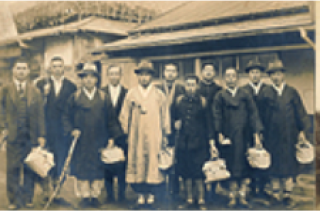
The Holiness Church of Korea is a proudly homegrown denomination that was founded by two Koreans, Kim Sang Jun and Jung Bin, before the arrival of foreign missionaries. The gospel of holiness first took root in Korea in 1907 with the Great Revival of the Korean Church, just as the Japanese invasion was in full swing. At the time, the Japanese were forcing Korean churches to worship at shrines, and the church was being oppressed.
Nevertheless, the Korean Holiness Church remained steadfast in its love for God with a martyr's spirit, and the missionary movement that began from that point onward took over the revival of John Wesley's Pentecostal movement and created the great wave of the Holy Spirit Movement. However, in 1943, at the height of Japanese imperialism, the Holiness Church was finally forcibly disbanded because Adventist doctrine blasphemed the divinity of the emperor.
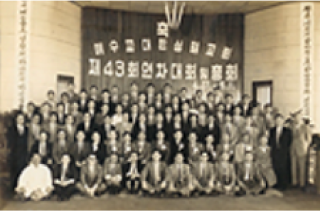
The Korean Holiness Church was rebuilt after a history of persecution with the liberation of Korea in 1945. But it was short-lived, as the church once again traveled through the deep tunnel of pain of the Korean War and denominational division. During the Korean War, more than 100 churches were closed and destroyed, and many clergy and laity were martyred or abducted. In April 1951, the church sent its first chaplain to the Korean army. However, the winds of liberal theology in the church led to the issue of joining the N.C.C. and N.S.E. in 1961, and the Holiness Church started anew under the name of the Jesus Korea Sungkyul Church (JKSC) by holding a joint special general assembly under the pain of defending the truth of the gospel.

Since then, JKSC has risen from the ashes of the 78 churches that remained after the departure of some churches in 1973, and has continued to grow in number and growth. In October 1992, the denomination hosted its first ‘JKSC World Mission Convention’ at Gymnasium 88. This wave of revival in the Holiness Church led to the Holiness World Conference. On October 1, 1995, 1,000 visitors from 57 countries, including the United States, Japan, Canada, and the United Kingdom, and 100,000 worshippers gathered at the Jamsil Olympic Stadium to celebrate the ‘95 AWF Convention and World Assembly of Holiness,’ a grand festival of Holiness that expanded the global reach of the Holiness Church.
On October 27, 2005, the church held the “JKSC 100th Anniversary Visioning Ceremony,” and on May 20, 2007, the “JKSC 100th Anniversary Convention” was held at the Sungkyul University Stadium to mark the 100th anniversary of the church's historic mission. With more than 20,000 pastors and members from all over the country gathered, the 100th anniversary celebration was a time of leapfrogging to conclude the 100 years of the church's mission and to confirm and proclaim the church's vision for a new future after 100 years.

Currently, JKSC has 1,500 churches (1,200 in Korea and 300 overseas), with 35 local churches in each region of the country, and one regional assembly and 10 district assembly in the Americas, Southeast Asia, Northeast Asia, Oceania, Southwest Asia, Africa, Oceania, Europe, Japan, Central Asia, and the Philippines. The denomination is organized into General Assembly, District Assembly, Supervisory Church Band, and local churches, with a general headquarters, executive board, executive committee, 17 parliamentary departments, and 16 executive departments. There are seven affiliated agencies, five associate agencies, six partner agencies, and nine partner organizations.
With this, the denomination is preparing for a new future missionary vision after completing the “JKSC Vision 2020 Project” which aimed to restore holiness through Bible education and revivalism, restore the identity of the church, and restore the evangelistic movement before the 2007 centennial convention.
JKSC is also active in external alliance ministries and cooperation. Along with its sister denomination, Korea Evangelical Holiness Church (KEHC), it also promotes exchanges with Korea National District Church of the Nazarene (KND). The three denominations hold annual general assemblies, New Year's worship services, and executive retreats under the name of the Korean Federation of Holiness Churches. In addition, the three denominations are expanding interdenominational cooperation and exchanges through the operation of nine subcommittees, including theology, education, overseas missions, domestic missions, social welfare, revival, laity, publications, and culture and sports, along with joint efforts to restore holiness, deal with homosexuality and the infiltration of Islamic forces, and renew the church.

Now, JKSC has begun a leap forward, embracing Korea and reaching out to the world. We will build our identity with the passionate evangelical faith of the ancient church and establish ourselves as a leading denomination in domestic evangelism and global mission.
The new ministries we are building together in the second century of mission are a movement to recover our first love for Christ, a proclamation of a vision that embraces society, and a holy step into the future. The JKSC will continue to be the hope of the world and will fulfill its role as light and salt to the world until the day of the Lord's return. And the unquenchable flame of holiness will continue to burn mightily for the evangelization of nations and humanity.
